Archive Record
Images
Metadata
Object Name |
Clipping, Newspaper |
Title |
Reproduction of newspaper article "Oak Cliff Railway" |
Date |
1961 |
Scope & Content |
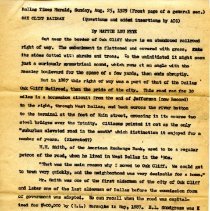
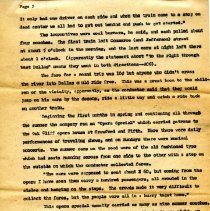
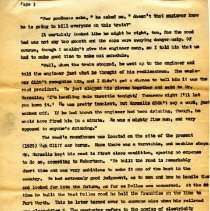
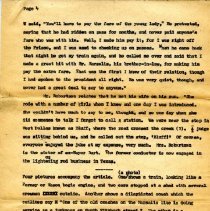
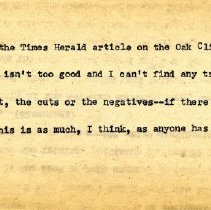
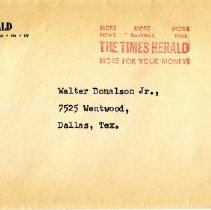
Reproduction of newspaper article "Oak Cliff Railway" by Mattie Lou Frye, sent by A.C. Greene to Walter P. Donalson Jr. - four pages newspaper retyped, note from A. C. G. to Donalson, envelope. a) Article transcribed: Dallas Times Herald, Sunday, Aug. 25, 1929 (Front page of a general sec.) OAK CLIFF RAILWAY (Questions and added insertations by ACG) By MATTIE LOU FRYE Out near the border of Oak Cliff there is an abandoned railroad right of way. The embankment is flattened and covered with grass, its sides dotted with shrubs and trees. To the uninitiated it might seem just a curiously symmetrical mound, which runs at an angle with the Kessler boulevard for the space of a few yards, then ends abruptly. But in 1887 this right of way was a part of that of the Dallas Oak Cliff Railroad, then the pride of the city. This road ran for 10 miles in a horseshoe circuit from the end of Jefferson (now Record) to the right, through West Dallas, and back across the river bottom to the terminal at the foot of Main street, crossing in its course two steel bridges over the Trinity. Citizens pointed it out as the only "suburban elevated road in the south" which distinction it enjoyed for a number of years. (Elevated?) H.H. Smith, of the American Exchange Bank, used to be a regular patron of the road, when he lived in West Dallas in the '90s. "That was the main reason why I moved to Oak Cliff. We could get to town very quickly, and the neighborhood was very desirable for a home." Mr. Smith was one of the first aldermen of the city of Oak Cliff and later one of the last aldermen of Dallas before the commission form of government was adopted. He can recall when the road was capitalized for $400,000 by (T.L.) Marsalis in May, 1887. E.L. Snodgrass was secretary and J.T. Elliot, treasurer. Isham Robertson, who now (1929) lives at 5222 Columbia, was a conductor on the old road, in 1890, and vividly recalls the little steam engines that used to pull the trains. "There were three trains, when I came to the road from the Frisco in the year '90, and three crews. M.G. Knight was the superintendent and T.L. Marsalis was president of the road. Soon after that the officials purchased two more engines which could pull better than the first ones we had. I will never forget old number two, which used to pull my run. Page 2 It only had one driver on each side and when the train came to a stop on dead center we all had to get out behind and push to get started." The locomotives were coal burners, he said, and each pulled about four coaches. The first train left Commerce (and Jefferson) street at about 5 o'clock in the morning and the last cars at night left there at about 1 o'clock. (Apparently the statement about "to the right through West Dallas" means they went in both directions--ACG). The fare for a round trip was 10c byt anyone who didn't cross the river into Dallas could ride free. This was a great boon to the children of the vicinity, apparently, as the conductor said that they would jump on his cars by the dozens, ride a little way and catch a ride back on another train. Beginning the first months in spring and continuing all through the summer the company ran an "Opera Special" which carried patrons to the Oak Cliff opera house at Crawford and Fifth. Here there were daily performances of traveling shows, and on Sundays there were musical concerts. The summer cars on the road were of the old fashioned type which had seats running across from one side to the other with a step on the outside on which the conductor collected fares. "The cars were supposed to seat about 60, but coming from the opera I have seen them carry a hundred passengers, all crowded in the aisles and hanging on the steps. The crowds made it very difficult to collect the fares, but the people were all in a hurry toget home." This opera special usually carried as many as nine summer coaches. Robertson tells the story that Marsalis was on the train one night, on the way to the opera house. "The train left the Main street station at 8 o'clock, made a very hurried trip by the Cliff Hotel to pick up the patrons there, and pull ed in before the opera house in time for the 8:15 curtain. Naturally, we had to do some fast running to make it. "That night the engineer whipped it up considerably as we started on the West Dallas run. Marsalis was on the last coach, and when I got back there to get his fare, he stopped me. Page 3 "For goodness sake," he asked me, "doesn't that engineer know he is going to kill everyone on this train?" It certainly looked like he might be right, too, for the road bed was not any too smooth and the cars were swaying dangerously. Of course, though I couldn't give the engineer away, so I told him that we had to make good time to make out schedule. "Well, when the train stopped, he went up to the engineer and told the engineer just what he thought of his recklessness. The engineer didn't recodgnize him and I didn't get a chance to tell him it was the road president. He just slapped his gloves together and said to Mr. Marsalis, 'I'm handling this throttle tonight. Tomorrow night I'll let you have it.' He was pretty insolent, but Marsalis didn't say a word, just walked off. If he had known the engineer had been drinking, though, he would have fired him in a minute. He was a mighty fine man, and very opposed to anyone's drinking." The road's roadhouse was located on the site of the present (1929) Oak Cliff car barns. Here there was a turntable, and machine shops. Mr. Marsalis kept his road in first class condition, sparing no expense to do so, according to Robertson. "He built the road in remarkably short time and was very ambitious to make it one of the best in the country. He had extremely good judgement, as to men and how to handle them, and looked far into the future, as far as Dallas was concerned. At the time he built the West Dallas road he held the franchise on the line to Fort Worth. This he later turned over to someone else when his railroad was electrified." The conductor refers to the coming of electricity as the days of the "fish pole cars." "Of course, in those days," said Mr. Robertson, "there weren't so many people in Oak Cliff, and I suppose I knew almost everyone of them, for everyone rode the train. It was the only way into town, for that was considerably before the street car's day in the section. One of our biggest crowds got on always at the new Cliff Hotel. I remember one night Marsalis got on and Gene Crowdus, his brother-in-law, got on with a young lady. I didn't know who Crowdus was, and when he flashed a pass at me, I took it, and noticed that it was specified only for him. Page 4 I said, "You'll have to pay the fare of the young lady," He protested, saying that he had ridden on pass for months, and never paid anyone's fare who was with him. Well, I made him pay for it, for I was right off the Frisco, and I was used to checking up on passes. When he came back that night he got my train again, and he called me over and said that I made a great hit with Mr. Marsalis, his brother-in-law, for making him pay the extra fare. That was the first I knew of their relation, though I had spoken to the president all right. He was very quiet, though, and never had a great deal to say to anyone." Mr. Robertson relates that he met his wife on his run. "She rode with a number of girls whom I knew and one day I was introduced. She wouldn't have much to say to me, though, and so one day when she did commence to talk I forgot to call a station. We were near the stop in West Dallas known as Bluff, where the road crossed the creek (?). A judge was sitting behind us, and he called out the stop, 'Bluff!' Of course, everyone enjoyed the joke at my expense, very much. Mrs. Robertson is the sister of ex-Mayor Burt. The former conductor is now engaged in the lightening rod business in Texas. ------- Four pictures accompany the article. One (a photo) shows a train, looking like a Forney or Mason bogie engine, and two cars stopped at a shed with several crewmen outside. Another shows a dilapidated coach which the cutlines say "One of the old coaches on the Marsalis line is doing service as a junkroom on South Fitzhugh street." The other is a birds-eye view, sort of SW from about Sangers, at the courthouse and the semi-circular run of the track. It is a drawing, of course, not a photo. A picture of Robertson is also shown. b) Note transcribed: Walter-- Here's the Times Herald article on the Oak Cliff. The reproduction on the pictures isn't too good and I can't find any trace of either the glossy print, the cuts or the negatives--if there were any negs. But at least, this is as much, I think, as anyone has ever put together on it. A.C.G. c) Envelope - Top left: Greene--books, The Dallas Times Herald, First in Dallas and growing...Owner of KRLD AM FM TV, Herald Square, Dallas 2, Texas; Center: Walter Donaldson Jr., 7525 Wentwood, Dallas, Tex.; Information-based indicia - Dallas Tex, Mar-6'61 |
Associated People |
Donalson, Walter P., Jr. Frye, Mattie Lou Greene, A. C. Marsalis, T. L. Robertson, Isham |
Search Terms |
Dallas Galveston Houston Electric Railway Lackawanna and Wyoming Valley Railroad Laurel Line Oak Cliff Railway West Dallas Railway Company |
Collection |
Walter P. Donalson III Collection |
Catalog Number |
CP.2025.CL.5-072 a-c |