Creator Record
Images
Metadata
Name |
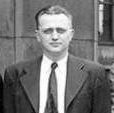
Krambles, George |
Other names |
Called 'GK' by friends and family. |
Dates & places of birth and death |
b. 11 Mar 1915 in Chicago, Cook Co., IL d. 24 Nov 1999 in Oak Park, Cook Co., IL |
Nationality |
American |
Occupation |
Krambles began working for the Chicago Rapid Transit during the Depression, rising to become executive director of the Chicago Transit Authority. His influence can still be felt not only in the "L" operations, rolling stock, and infrastructure, but also in its railfan culture, academic literature, and the education of young transit enthusiasts. He was truly a renaissance man of the Chicago elevated. In 1936, at age 21, George was working for the Indiana Railroad interurban as a management trainee, and by 1937 as a junior engineer and power supervisor in the Chicago Rapid Transit's Edison Building office, the precursor to the CTA's Control Center. Given his connection to management, he had better insight (than a lot of the employees) into how the property was doing financially, etc. For example, when the substation operators went on strike, George knew the line couldn’t afford the settlement to the strike and that’s when he decided to leave Indiana Railroad. George joined the Chicago Transit Authority, formed in 1945 to assume ownership and operation of Chicago's bankrupt private transit companies, in the Operations Planning Department where he innovated many engineering and efficiency steps, among them the redevelopment of the Skokie Swift, or Yellow Line, which had been suspended in 1948 though the North Shore Line continued to use the tracks until January of 1963. To preserve that portion of the interurban, the CTA applied to the U.S. Housing and Home Finance Agency for a grant to subsidize a new service on the old line between Skokie and the Chicago city limits. It began operation on April 20, 1964 and was an instant success far beyond expectations. In 1976, George Krambles assumed leadership of the CTA, and retired four years later after 43 years of service in transit to become a transit consultant for new and existing projects worldwide while remaining active in the American Public Transit Association, the International Union of Public Transport, the Western Society of Engineers, and the Advanced Transit Association and on the Executive Committee of the Transportation Research Board. He also chaired a panel on the Congressional Office of Technology Assessment of the US Congress, provided expert testimony to legislative bodies on funding and regulatory matters. |
Notes |
The Krambles-Peterson Archives is the collection of George Krambles managed by his nephew Arthur 'Art' Peterson, son of Elaine Louise Krambles Petereson, George's only sibling. See https://www.cera-chicago.org/Profile-of-George-Krambles. George was cremated in accordance with his wishes and we scattered his ashes along the Oakton Curve on the Skokie Swift (former North Shore Line) right-of-way on May 6, 2000. I [Art Peterson] stood on the back end sill of CTA 4271-72 (the cars George was instrumental in saving) and scattered the ashes as the train moved slowly through the curve. A fitting end to a life well lived. |
Publications |
George was fundamental in CERA's publications program which now includes 151 Bulletins (including coverage of Texas Electric Railway in Bulletin 121). He also took some of the earliest movies of Texas Electric Railway. |
Relationships |
It was during the late 1930's that Krambles made one of many lasting contributions to the transit community. George, along with Frank Butts and Barney Stone, formed the Central Electric Railfans' Association (CERA), a group dedicated to the study of the history, equipment and operation of urban, suburban, interurban, and main line electric railways. As member #1, Krambles was also its first chairman and publication director. GK continued to contribute to CERA throughout his life, from trip organization to publication contributions. He even made one of his first contributions to the lexicon here: he coined the term "railfan" to refer to admirers of railroading. The term was typical of his lifelong passion to find ways to "reduce the bulk," a talent he would be able to fully demonstrate with the CTA. The CERA almost immediately began doing one of things it was most famous for: operating "fantrips", chartered train rides over various railroad properties for the purposes of fun and education. GK frequently participated in their planning and operation. For example, George maintained his contacts at the IR, allowing CERA to operate several trips on that system up to it's late 1941 demise. GK also gave several CERA programs, including the very first one in October of 1938, where he showed movies. |
Role |
Engineer |
Titles & Honors |
Inducted into the American Public Transit Association Transit Hall of Fame in 1995. |
Education |
A traction enthusiast by 18, he earned a degree in Railway Electrical Engineering from the University of Illinois at Champaign-Urbana. In later years, Krambles founded the nonprofit George Krambles Transit Scholarship Fund corporation to award grants to undergraduate or graduate students seeking professional careers in the transit industry. |
Related Records
-
DR&TC Streetcar 761 in Oak Cliff Junction - 1938, September 17
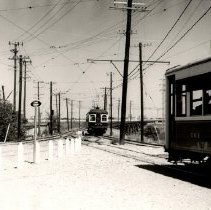
A rear view of Dallas Railway & Terminal Company (DR&TC) streetcar 761 indicates it has just passed an unidentified Texas Electric Railway Company Passenger Motor approaching the Trinity River Viaduct before reaching Dallas. The two cars passed in Oak Cliff Junction. Note the oval 'Car Stop' sign to the left of the white posts. See: Map 8
Record Type: Photo
-
Indiana Railroad System - Krambles, George
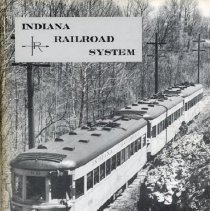
This book discusses the history, rolling stock, freight, passenger service, and more of the Indiana Railroad System. Also includes removable fold out with a equipment table.
Record Type: Library
-
Interior View of TER Passenger Motor 370 - 1938, September 14
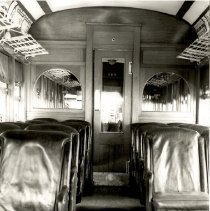
Interior rear-facing view of Texas Electric Railway Company Passenger Motor 370. This car had the luxurious leather seating. See: Map 3, 8
Record Type: Photo
-
South of Plano, Cotton Belt Crossing, July 4, 1948 - 1948, July 4
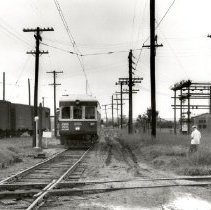
Northbound Texas Electric Railway 'Special' Passenger Motor 365 is stopped at the Cotton Belt and Texas Electric Railway crossing, also called the Plano interlocking (St Louis Southwestern), about a half mile south of downtown Plano. The car is stopped at the push-button which controls signals. The Motorman is pushing the button to set the signals [throw the automatic derail switch] against SSW (Cotton Belt) to clear the crossing for Texas Elec...
Record Type: Photo
-
TER Bluebonnet Passenger Motor 310 Boarding Passengers - 1938, September
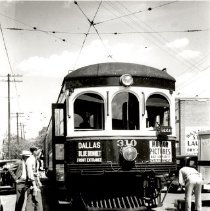
Texas Electric Railway Company Bluebonnet Passenger Motor 310 [Train 221], boards passengers in Waxahachie, on it's route north to Dallas. Advertising under the motorman's seat reads: Motion Pictures are your best entertainment See: Map 4, Detail 38
Record Type: Photo
-
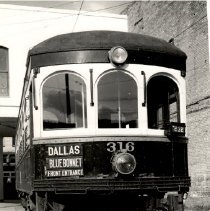
TER 'Bluebonnet' Passenger Motor 316 at Waco Terminal - 1938, September 15
Texas Electric Railway Company Passenger Motor 316 [Train 232], a Bluebonnet, stands at the Waco Terminal. See: Map 7, Waco Downtown Detail
Record Type: Photo
-
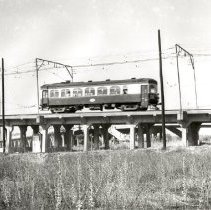
TER Car on South Bank Crossing of Trinity River Viaduct - 1938, September 17
Texas Electric Railway Car on the south bank crossing, near the Dallas end, of the Trinity River Viaduct. Note the catenary overhead wire structure, used for speeding up the car, over the viaduct. See: Map 8
Record Type: Photo
-
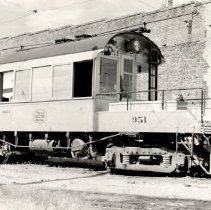
TER Class C Locomotive 951 at Denison Station - 1938, September
Texas Electric Railway Company Class "C" Locomotive 951 beside Denison Station. In 1907, Texas Traction Company, as part of its original equipment order, purchased ten new 600 volt two-man passenger coach motors from St Louis Car Company, of which Interurban Motor 3 was one. In 1913, at the integration of Southern Traction and Texas Traction, it was renumbered 352 and assigned the same tasks as formerly. In 1917, Passenger Motor 352, was...
Record Type: Photo
-
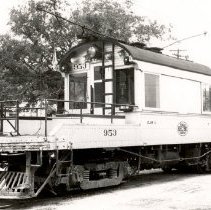
TER Class C Locomotive 953 in Sherman - 1948, July 4
Texas Electric Railway Company Class "C" Locomotive 953 in Sherman; right 3/4 view. 953 was built from Passenger Trailers 402 and 404. It was used as a 600 volt freight motor until the final days of Texas Electric Railway Company in 1948, at which time it was dismantled. See: Map 1, Detail 4
Record Type: Photo
-
TER Class C Locomotive 953 in Sherman - 1948, July 4
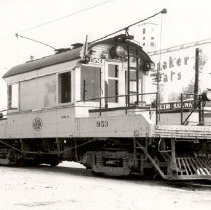
Texas Electric Railway Company Class "C" Locomotive 953 in Sherman, likely at the Sherman Yards; left 3/4 view. Rising behind 953 is the Quaker Oats Company Grain Elevator, which sat off of Lamar Street. 953 was built from Passenger Trailers 402 and 404. It was used as a 600 volt freight motor until the final days of Texas Electric Railway Company in 1948, at which time it was dismantled. See: Map 1, Detail 4
Record Type: Photo
-
TER Executives Peters and Floyd on CERA Fan Trip - 1948, July 3
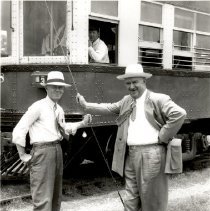
Texas Electric Railway Company Executives George Harris Peters, Power Superintendent and Horace Greeley Floyd, Superintendent, hold a guy wire beside Passenger Motor 328 as it's stopped in north Waco. The Motorman looks on. Another view of this scene can be found at CP.2022.CL.20-240. See: Map 7, Detail 71
Record Type: Photo
-
TER Express Motor 509 at Dallas Freight Terminal - 1938, September 17
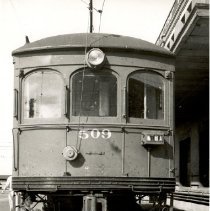
Texas Electric Railway Express Motor 509 [Train 81] at the Dallas Freight Terminal; head-on view. See: Map 8, Detail B
Record Type: Photo
-
TER Express Motors 503, 502 & 501 in Center Bay of Dallas Freight Terminal - 1938, September
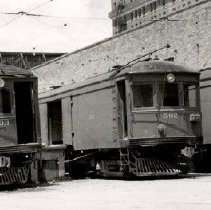
An unusual photo of Texas Electric Railway Express Motors 503, 502 and 501 in the center bay of the Dallas Freight Terminal. See: Map 8, Detail B
Record Type: Photo
-
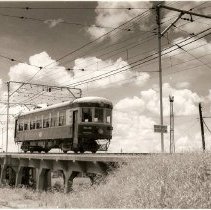
TER 'Extra' Passenger 328 Inbound to Dallas at Young Street - 1948, July 3
Texas Electric Railway Passenger Motor 328 inbound to Dallas at Young Street PRW (Private Right-of-Way). See: Map 8, Detail B
Record Type: Photo
-
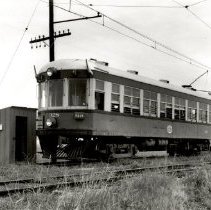
TER 'Extra' Passenger Motor 328 at Ash Siding - 1948, July 3
Southbound Texas Electric Railway Company 'Extra' Passenger Motor 328 [Train 328] stopped at Ash Siding. This 'extra' car was reserved for the CERA Fantrip on this date. See: Map 4 Detail 40
Record Type: Photo
-
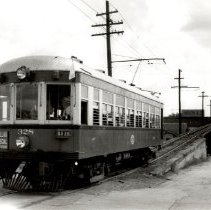
TER 'Extra' Passenger Motor 328 at Foot of Waxahachie Viaduct - 1948, July 3
SNAPSHOT: Texas Electric Railway Company Passenger Motor 328 at the foot (north end) of the Waxahachie viaduct. See: Map 4, Detail 38
Record Type: Photo
-
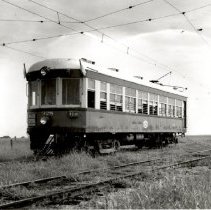
TER 'Extra' Passenger Motor 328 at Niles Siding - 1948, July 3
Texas Electric Railway Company Passenger Motor 328 at Niles Siding. See: Map 3, Detail 26
Record Type: Photo
-
TER 'Extra' Passenger Motor 328 in East Waco - 1948, July 3
Southbound Texas Electric Railway Company 'Extra' Passenger Motor 328 [Train 328] stopped in east Waco. This 'extra' car was reserved for the CERA Fantrip on this date. See: Map 7 Detail 71
Record Type: Photo
-
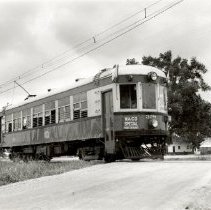
TER 'Extra' Passenger Motor 328 in West - 1948, July 3
Southbound Texas Electric Railway Company 'Extra' Passenger Motor 328 [Train 328] on Regan Street in West. This 'extra' car was reserved for the CERA Fantrip on this date. See: Map 7 Detail 67
Record Type: Photo
-
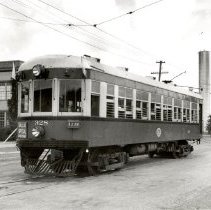
TER 'Extra' Passenger Motor 328 in West Texas - 1948, July 3
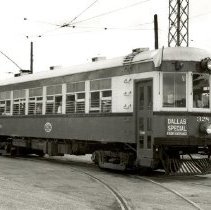
Texas Electric Railway Company 'Extra' Passenger Motor 328 in West, Texas. Note the prominent white flags on each side of the car. These indicated a car was a 'Special', in this case a 'Dallas Special' as noted on the front sign by the passenger entry. Another term for this type car was an 'extra'; in this case, 'extra 328'. The flags were also used to indicate a car was not on a schedule; it was running between scheduled trains. The perfec...
Record Type: Photo