Person Record
Images
Metadata
Name |
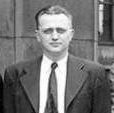
Krambles, George |
Othernames |
Called "GK" by family and friends. |
Born |
11 Mar 1915 |
Birthplace |
Chicago, Cook Co., IL |
Titles & honors |
Inducted into the American Public Transit Association Transit Hall of Fame in 1995. |
Father |
Prucorpius "Peter" Aristedis Karambelas |
Mother |
Hermeno Fleurdilys Bundesen |
Education |
A traction enthusiast by 18, he earned a degree in Railway Electrical Engineering from the University of Illinois at Champaign-Urbana. In later years, Krambles founded the nonprofit George Krambles Transit Scholarship Fund corporation to award grants to undergraduate or graduate students seeking professional careers in the transit industry. |
Notes |
The Krambles-Peterson Archives is the collection of George Krambles managed by his nephew Arthur 'Art' Peterson, son of Elaine Louise Krambles Petereson, George's only sibling. See https://www.cera-chicago.org/Profile-of-George-Krambles. George was cremated in accordance with his wishes and we scattered his ashes along the Oakton Curve on the Skokie Swift (former North Shore Line) right-of-way on May 6, 2000. I [Art Peterson] stood on the back end sill of CTA 4271-72 (the cars George was instrumental in saving) and scattered the ashes as the train moved slowly through the curve. A fitting end to a life well lived. |
Occupation |
Krambles began working for the Chicago Rapid Transit during the Depression, rising to become executive director of the Chicago Transit Authority. His influence can still be felt not only in the "L" operations, rolling stock, and infrastructure, but also in its railfan culture, academic literature, and the education of young transit enthusiasts. He was truly a renaissance man of the Chicago elevated. In 1936, at age 21, George was working for the Indiana Railroad interurban as a management trainee, and by 1937 as a junior engineer and power supervisor in the Chicago Rapid Transit's Edison Building office, the precursor to the CTA's Control Center. Given his connection to management, he had better insight (than a lot of the employees) into how the property was doing financially, etc. For example, when the substation operators went on strike, George knew the line couldn’t afford the settlement to the strike and that’s when he decided to leave Indiana Railroad. George joined the Chicago Transit Authority, formed in 1945 to assume ownership and operation of Chicago's bankrupt private transit companies, in the Operations Planning Department where he innovated many engineering and efficiency steps, among them the redevelopment of the Skokie Swift, or Yellow Line, which had been suspended in 1948 though the North Shore Line continued to use the tracks until January of 1963. To preserve that portion of the interurban, the CTA applied to the U.S. Housing and Home Finance Agency for a grant to subsidize a new service on the old line between Skokie and the Chicago city limits. It began operation on April 20, 1964 and was an instant success far beyond expectations. In 1976, George Krambles assumed leadership of the CTA, and retired four years later after 43 years of service in transit to become a transit consultant for new and existing projects worldwide while remaining active in the American Public Transit Association, the International Union of Public Transport, the Western Society of Engineers, and the Advanced Transit Association and on the Executive Committee of the Transportation Research Board. He also chaired a panel on the Congressional Office of Technology Assessment of the US Congress, provided expert testimony to legislative bodies on funding and regulatory matters. |
Publications |
George was fundamental in CERA's publications program which now includes 151 Bulletins (including coverage of Texas Electric Railway in Bulletin 121). He also took some of the earliest movies of Texas Electric Railway. |
Relationships |
It was in 1938 that Krambles made one of many lasting contributions to the transit community. George, along with Frank Butts and Barney Stone, formed the Central Electric Railfans' Association (CERA), a group dedicated to the study of the history, equipment and operation of urban, suburban, interurban, and main line electric railways. As member #1, Krambles was also its first chairman and publication director. GK continued to contribute to CERA throughout his life, from trip organization to publication contributions. He even made one of his first contributions to the lexicon here: he coined the term "railfan" to refer to admirers of railroading. The term was typical of his lifelong passion to find ways to "reduce the bulk," a talent he would be able to fully demonstrate with the CTA. The CERA almost immediately began doing one of things it was most famous for: operating "fantrips", chartered train rides over various railroad properties for the purposes of fun and education. GK frequently participated in their planning and operation. For example, George maintained his contacts at the IR, allowing CERA to operate several trips on that system up to it's late 1941 demise. GK also gave several CERA programs, including the very first one in October of 1938, where he showed movies. |
Role |
Engineer |
Related Records
-
![TER Envelope with RPO Cancel and RMS Stamps [Front]](https://s3.amazonaws.com/pastperfectonline/images/museum_1030/016/thumbs/cp2022cl20278.jpg)
-
![Postcard: Address Side of Postcard with RPO Cancel and RMS Stamps [1938]](https://s3.amazonaws.com/pastperfectonline/images/museum_1030/016/thumbs/cp2022cl20284.jpg)
-
![Postcard with RPO Cancel and RMS Stamps [1941]](https://s3.amazonaws.com/pastperfectonline/images/museum_1030/016/thumbs/cp2022cl20282.jpg)
-
![Postcard with RPO Cancel and RMS Stamps [1941]](https://s3.amazonaws.com/pastperfectonline/images/museum_1030/016/thumbs/cp2022cl20283.jpg)
-
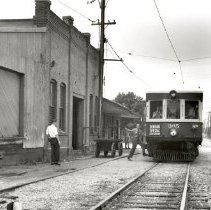
TER 'Extra' Passenger Motor 365 Leaving Plano Station - 1948, July 4
Texas Electric Railway Company Passenger Motor 365 about to depart Plano Station. Here, George Krambles is seen rushing to get back on the car. One of the duties of the trip director was to "herd the cats in" at each photo stop, and thus get the car on to the next destination on-time! But, passenger Thomas Desnoyers was apparently the last rider on as he was taking this photo! See: Map 2, Detail 21
Record Type: Photo